Publication information
Immigration and Refugee Board of Canada
Minto Place, Canada Building
344 Slater Street, 12th floor
Ottawa, Ontario
Canada
K1A 0K1
© His Majesty the King in Right of Canada, as represented by the Minister of Immigration, Refugees and Citizenship, 2026.
MQ2-5E-PDF (Electronic PDF, English)
ISSN 2564-355X
On this page
Introduction
This quarterly financial report has been prepared by management as required by section 65.1 of the Financial Administration Act and in the form and manner prescribed by the Treasury Board. This report is consistent with the 2025 to 2026 Main Estimates, the 2024 to 2025 Quarterly Financial Report and the 2025 to 2026 Departmental Plan. The report has not been subject to an external audit or review.
The Immigration and Refugee Board (IRB) is an independent, accountable administrative tribunal established by Parliament on January 1, 1989, to resolve immigration and refugee cases fairly, efficiently and in accordance with the law. Through providing quick and fair administrative justice, the IRB contributes to Canadians' confidence in their democratic institutions and, therefore, the quality of life in Canada.
A summary description of the IRB's programs can be found in the 2025 to 2026 Departmental Plan.
Basis of presentation
This quarterly report has been prepared by management using an expenditure basis of accounting. The accompanying Statement of Authorities includes the IRB's spending authorities granted by Parliament and those used by the IRB in a manner consistent with the 2025 to 2026 Main Estimates. This quarterly report has been prepared using a special purpose financial reporting framework designed to meet financial information needs with respect to the use of spending authorities.
The authority of Parliament is required before money can be spent by the Government. Approvals are given in the form of annually approved limits through appropriation acts or through legislation in the form of statutory spending authority for specific purposes.
When Parliament is dissolved for the purposes of a general election, section 30 of the Financial Administration Act authorizes the Governor General, under certain conditions, to issue a special warrant authorizing the Government to withdraw funds from the Consolidated Revenue Fund. A special warrant is deemed to be an appropriation for the fiscal year in which it is issued.
The IRB uses the full accrual method of accounting to prepare and present its annual departmental financial statements that are part of the departmental performance reporting process. However, the spending authorities voted by Parliament remain on an expenditure basis.
Highlights of fiscal quarter and fiscal year-to-date (YTD) results
This section highlights the significant items that have contributed to the net increase or decrease in use of financial resources available and actual expenditures for the year and for the quarter ended December 31, 2025, in comparison to the prior year.
Consistent with practices used across federal departments comparable in size and mandate to the IRB, variances greater than $5 million and representing more than a 10% year‑over‑year change in authorities or expenditures are considered significant for analysis and disclosure.
Figure 1. Comparison of net budgetary authorities and expenditures for the quarter ended December 31 of fiscal years 2024 to 2025 and 2025 to 2026 (in millions of dollars)
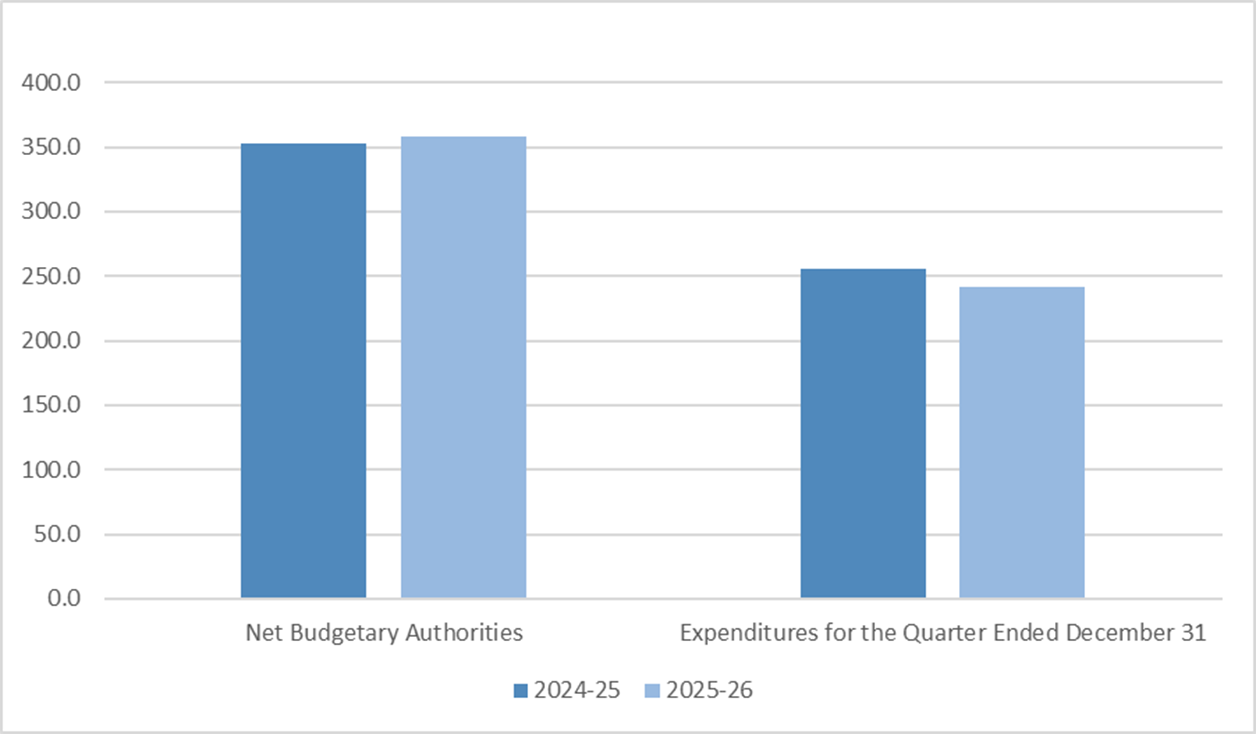
Text format - Figure 1. Comparison of net budgetary authorities and expenditures for the quarter ended December 31 of fiscal years 2024 to 2025 and 2025 to 2026 (in millions of dollars)
| 2024-25 | 2025-26 |
|---|
| Net budgetary authorities | 352.7 | 357.7 |
Expenditures for the quarter ended December 31
| 255.2 | 241.6 |
Year to date, the total budgetary authorities available of $357.7 million represent an increase of 1.4%, or $5.0 million, compared to the same period in the previous fiscal year. Since the last quarter, overall available authorities have increased by $0.6 million.
In the quarter ending December 31, 2025, the IRB spent $82.5 million, representing a decrease of $4.4 million (5.0%) compared to the $86.9 million spent during the same quarter last year. This reduction is primarily driven by lower expenditures in personnel and in professional and special services.
Overall, spending trends in personnel and in professional and special services remain consistent with departmental efforts to manage resources prudently while continuing to support core operations and program delivery effectively.
Risks and uncertainties
The IRB operates in a complex and rapidly evolving environment characterized by sustained high intake volumes, resource pressures, and system‑wide capacity constraints. The renewal of the IRB's temporary funding for an additional two years, announced in Budget 2025, will allow the Board to maintain enhanced capacity through 2026 to 2027 and 2027 to 2028, supporting service continuity and mitigating short‑term operational risks.
A voluntary early retirement incentive program has been proposed as part of the Government's broader effort to reduce the federal public service to a more sustainable size by 2028 to 2029. While these measures support long‑term fiscal objectives, they introduce risks related to workforce capacity, talent retention, and the IRB's ability to maintain productivity and service standards.
High intake volumes at the Refugee Protection Division continue to result in inventories above working levels. Without predictable and sufficient funding, the IRB may face challenges sustaining adjudicative capacity, optimizing operations, and meeting service commitments. System‑wide constraints among partner organizations may further affect the Board's ability to process cases efficiently.
To mitigate these risks, the IRB is advancing its Horizon 2026 to 2027 modernization agenda, which focuses on strengthening operational efficiency, national consistency, and client service. Key initiatives include enhanced digital tools to streamline intake, scheduling, and decision‑writing; standardized processes across regions; and lean process improvements to reduce duplication and improve workflow. These initiatives support the IRB's ability to manage high volumes, improve productivity, and maintain service delivery within a constrained fiscal environment.
The IRB continues to monitor fiscal developments, including the implementation of Budget 2025, and will adjust its workforce and operational plans as required. The organization remains committed to transparency, timely decision‑making, and supporting employees through periods of change, guided by the values of fairness, consistency, and respect for diversity.
Significant changes related to operations, personnel and program
On November 1, the Minister of Immigration and Refugees and Citizenship Canada tabled the IRB's first annual Departmental Sustainable Development Strategy (DSDS), for 2023 to 2024. The Report provides an annual update for Canadians on the progress made toward IRB's 2023 to 2027 DSDS commitments.
Although this leadership change falls outside the Q3 reporting period, in December 2025 we announced the planned departure of our Chief Financial Officer, Hongchao Wang, effective January 2026. Following this announcement, an organizational restructuring was completed, and Roger Ermuth has assumed the role of Chief Financial Officer.
Attestation
The original version was signed by
Manon Brassard
Chairperson
Roger Ermuth
Executive Director and Chief Financial Officer
Ottawa, Canada
February 25, 2025
Statement of authorities (unaudited)
Statement of authorities (unaudited)
| Authorities (in thousands of dollars) | Fiscal year 2025 to 2026 | Fiscal year 2024 to 2025 |
|---|
| Total available for use for the year ending
March 31, 2026* | Used during the quarter ended
December 31, 2025 | Year to date used at quarter end | Total available for use for the year ending
March 31, 2025* | Used during the quarter ended
December 31, 2024 | Year to date used at quarter end |
|---|
Vote 1 - Net operating expenditures | 321,259 | 73,411 | 214,317 | 321,287 | 79,037 | 231,609 |
Budgetary statutory authorities | 36,442 | 9,111 | 27,332 | 31,421 | 7,859 | 23,571 |
Total budgetary authorities | 357,701 | 82,522 | 241,649 | 352,708 | 86,896 | 255,180 |
Total authorities | 357,701 | 82,522 | 241,649 | 352,708 | 86,896 | 255,180 |
* Includes only authorities available for use and granted by Parliament at quarter-end.
Departmental budgetary expenditures by standard object (unaudited)
| Expenditures (in thousands of dollars) | Fiscal year 2025 to 2026 | Fiscal year 2024 to 2025 |
|---|
| Planned expenditures for the year ending
March 31, 2026* | Expended during the quarter ended
December 31, 2025 | Year to date used at quarter end | Planned expenditures for the year ending
March 31, 2025* | Expended during the quarter ended
December 31, 2024 | Year to date used at quarter end |
|---|
Personnel | 286,286 | 71,289 | 213,073 | 262,826 | 74,821 | 218,131 |
Transportation and communications | 2,605 | 296 | 536 | 4,298 | 554 | 1,247 |
Information | 684 | 67 | 290 | 765 | 20 | 351 |
Professional and special services | 46,562 | 8,703 | 21,086 | 42,265 | 9,569 | 26,323 |
Rentals | 9,467 | 998 | 4,352 | 10,039 | 1,373 | 5,447 |
Repair and maintenance | 7,958 | 88 | 143 | 14,310 | 190 | 319 |
Utilities, materials and supplies | 650 | 79 | 150 | 908 | 50 | 227 |
Acquisition of land, buildings and works | - | - | - | 415 | - | - |
Acquisition of machinery and equipment | 3,429 | 776 | 1,231 | 16,642 | 183 | 2,292 |
Other subsidies and payments | 60 | 226 | 788 | 240 | 136 | 843 |
Total gross budgetary expenditures | 357,701 | 82,522 | 241,649 | 352,708 | 86,896 | 255,180
|
Total net budgetary expenditures | 357,701 | 82,522 | 241,649 | 352,708 | 86,896 | 255,180
|
* Includes only authorities available for use and granted by Parliament at quarter-end.